- Author:
- Tillie Dee
- Date:
What happens when a citizens assembly comes home?
After taking part in a Global Assembly, Anna Mbabazi brought the conversation back home to her village in Uganda, showing how deliberative democracy can spread from one community to another.
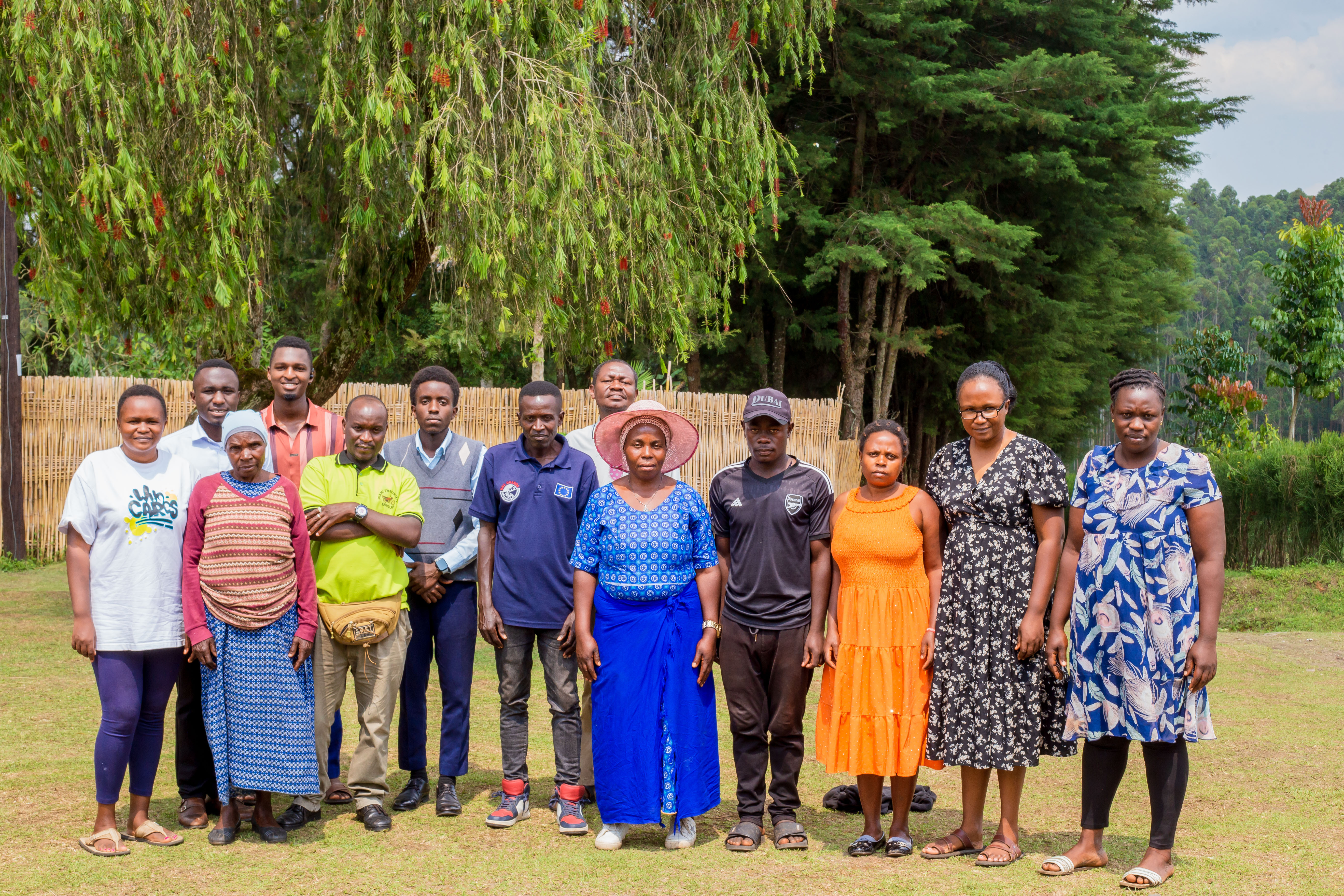
Anna Mbabazi keeps cattle and grows maize on a small plot in western Uganda.
Earlier this year, she joined 104 ordinary citizens from more than 60 countries and territories on video calls, twice a week, for seven weeks. It was the Global Citizens' Assembly on Food Systems and Climate, people chosen by lottery, working through hard evidence on food systems and climate together.
Then, months after the closing session, something unexpected happened. Anna hadn't just gone home and got on with life. On July 25th, she gathered her own community in the village of Kyakaigo. No government told her to. No summit asked her to. She just brought home what she'd learned and asked her neighbors to sit down and talk it through too, so that together they could start to make change happen.
Sitting in a room with strangers
Try to remember the last time you sat with people who disagreed with you and actually worked something out together. It's hard, isn't it? Most of us can't think of one because it’s vanishingly rare.
That's essentially what these assemblies are built to do. People listen as much as they talk. They weigh up trade-offs that don't have easy answers. Slowly, they move from a gut feeling toward something closer to informed judgement.
Researchers call it a kind of school for democracy. Studies in the Journal of Deliberative Democracy have found that going through this kind of deliberation measurably raises people's trust in democratic institutions, as well as their sense that their own voice actually counts.
The Global Citizens' Assembly's own evaluation backs this up. Half the participants in the Civic Assembly said they planned to stay involved as activists afterward, nearly double the number who were active before they joined. Intention to stay informed about global politics rose sharply too.
But the part of the evaluation that stuck with people most was something they called community spillover. It started showing up even before the assembly had officially finished. Members were already talking about setting up local groups of their own once they had finished with the Global Assembly.
Local knowledge meets global dialogue
What's striking about Kyakaigo is how naturally the big abstract conversation turned into a local one. Climate-smart farming came up. So did protecting natural resources. So did food security and looking after the community. These are the same themes running through the Global Assembly's 22 Calls to Action, just now grounded in one Ugandan village's actual life.
That's deliberative democracy doing what it does best. It takes a distant, slow-moving crisis and connects it to the decisions communities are already making about growing food and caring for their land.
It's also a good reminder that these assemblies aren't meant to take something from people and disappear. They're meant to leave people better equipped, with knowledge, with contacts, with a sense of what a room full of ordinary people can actually pull off, so they can keep the conversation going in whatever way makes sense to them.
A growing global track record
Kyakaigo, and the wider Global Citizens' Assembly, sit inside a much longer track record.
The OECD now counts more than 730 representative deliberative processes since 1979, with over 80,000 citizens randomly selected to take part along the way.
Ireland's Citizens' Assembly recommended a referendum on same-sex marriage in 2015, and another on abortion in 2018, both passed, on issues Irish politicians had avoided for decades. France ran its own Citizens' Convention on Climate, which fed directly into the country's Climate Act.
This is evidence of a pattern. If we give ordinary citizens the time, information and structure to deliberate seriously, they consistently produce recommendations robust enough to shift policy.
Every voice, multiplied
Anna ended her reflections on the day with a simple line.
“The future we want starts with the actions we take today.”
It's a fitting echo of what the Global Citizens' Assembly is trying to do in the first place. These assemblies don't really end when the closing session wraps up. They plant something, and people carry it home with them.
People talk a lot about scaling deliberative democracy by reaching more people and more decision-making tables. But Kyakaigo is a reminder that scale doesn't always mean size. Sometimes it just means one person going home with a new conviction, and deciding to bring a few others along with her.
Maybe that's the real test of a citizens' assembly, in the end. Not just what it recommended. But who it changed, and what they went on to build because of it.